Current Courses
Follow us on LinkedIn to be the first to know about SMES Offerings!
Fundamentals of Curriculum Development
GenAI Assisted Online Course- November 16, 17 & 18, 2026
(9 AM- 2 PM ET)
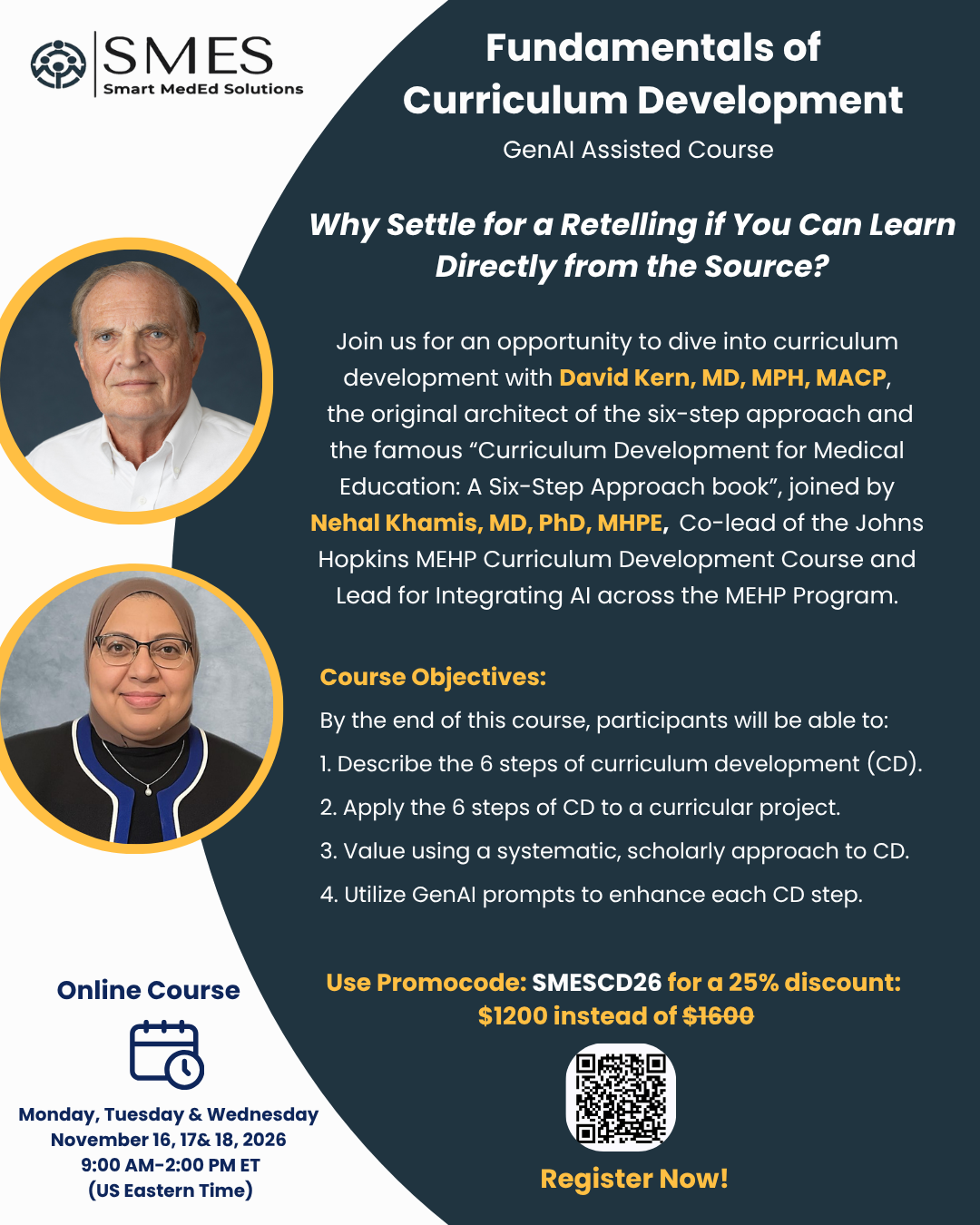
Limited Time 25% Discount: Use Promo Code SMESCD26 at Checkout and Pay $1200 instead $1600.
Course Overview:
Join an immersive, interactive, and GenAI-assisted learning experience that goes beyond theory to equip you with the skills, tools, and personalized guidance needed to design and evaluate effective health professions curricula.
Master a Systematic, Evidence-Based Approach: Apply Kern’s six-step approach to curriculum development, integrating educational theory, evidence, and real-world application.
Experience Our New Interactive Online Course Workspace: Engage in an integrated learning environment that brings together customizable GenAI prompts, AI-assisted feedback tailored to group inputs, collaborative activities, and progressive curriculum development, without the need to repeatedly copy and paste between tools.
Engage in Experiential Group Tasks: Collaborate with peers on authentic curriculum projects, critically review AI-generated outputs, and progressively develop and refine curriculum plans.
Receive Expert Faculty Feedback: Benefit from real-time feedback, personalized guidance, and practical insights from experienced curriculum development educators throughout the course.
Take Home a Comprehensive Course Workbook: Receive a reusable workbook featuring step-by-step templates, brainstorming questions, customizable GenAI prompts, and practical resources to support your current and future curriculum development projects.
Whether you are developing a new curriculum or refining an existing one, this course combines the rigor of evidence-based curriculum development with the efficiency of GenAI, collaborative learning, and expert faculty guidance to help you design meaningful, feasible, and effective educational programs.
Course Facilitators:
David Kern, MD, MPH, MACP
Emeritus Professor of Medicine, School of Medicine, Johns Hopkins University
Nehal Khamis, MD, PhD, MHPE, MAMSE (affil.)
Adj. Professor, Co-Lead of the Curriculum Development Course and Lead of GenAI Integration, Masters of Education in Health Professions (MHPE) Program, Johns Hopkins University.
Course Dates: Monday, Tuesday & Wednesday, November 16, 17 & 18, 2026 (9 AM- 2 PM ET).
Course Fees: Please fill the registration form and proceed to checkout to reach the payment page. You will receive a payment confirmation email. This is important to confirm your registration.
Limited Time 25% Discount: Use Promo Code SMESCD26 at Checkout and Pay $1200 instead $1600.
A payment processing fees of 2.9%+ 0.30 USD is added by the payment processing provider so your total at checkout will be S1236. These processing charges go to the payment processing provider and not to SMES.
Past Courses
Stay Tuned for the Next Offering of these Courses
Dates to be Announced Soon
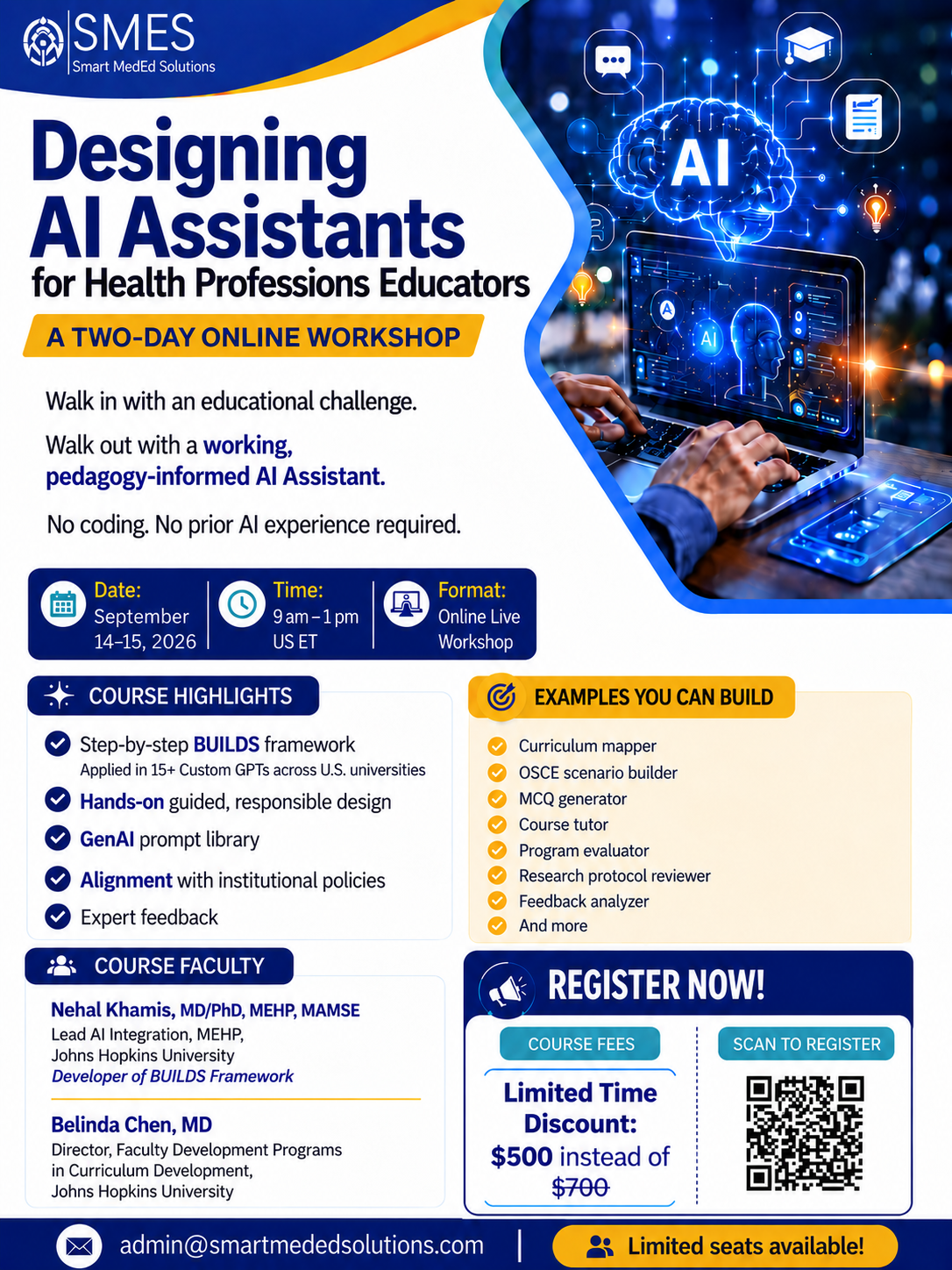
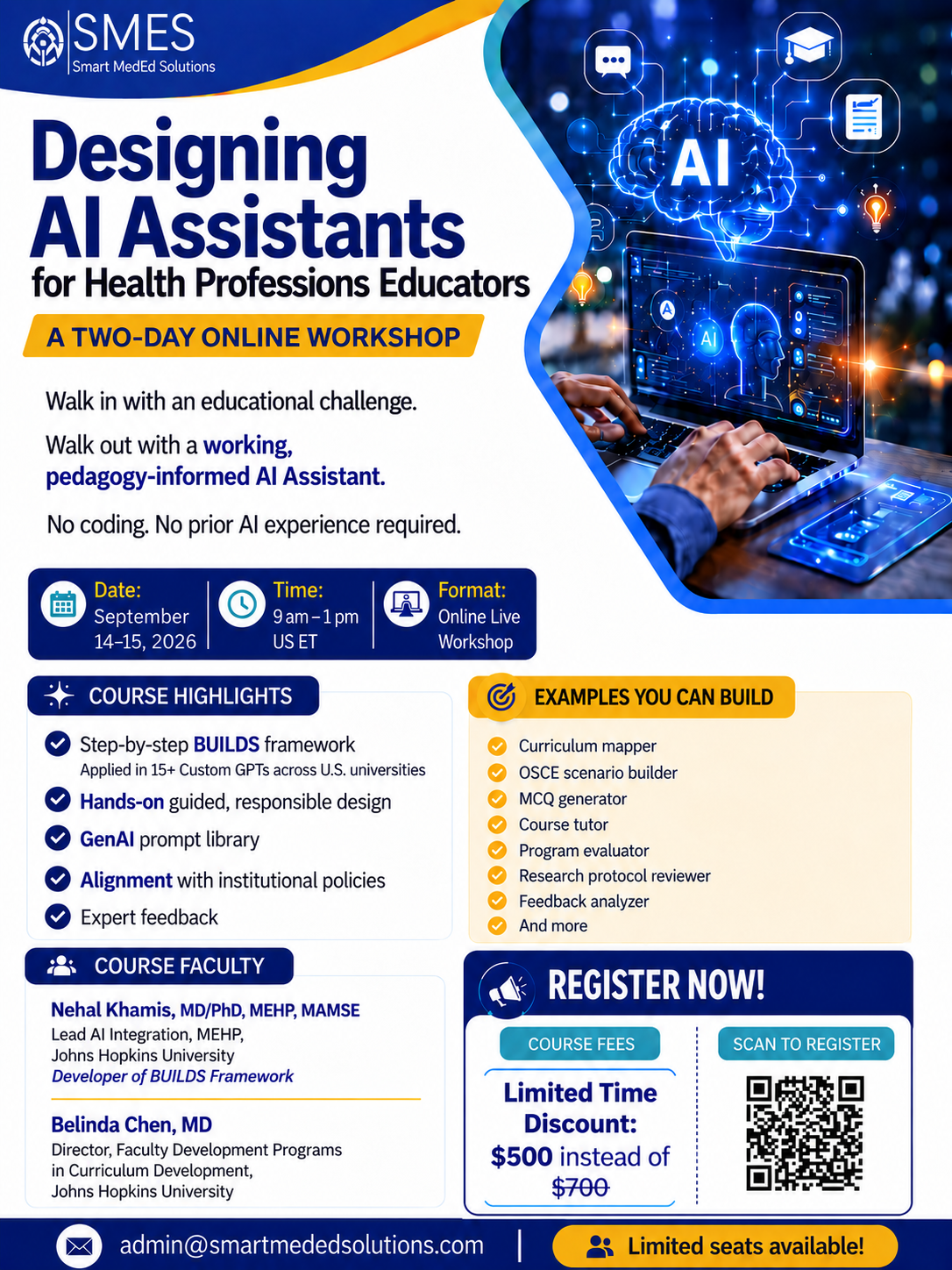
Designing AI Assistants
for Health Professions Educators
GenAI-Assisted Online Workshop
Overview
Many health professions educators are interested in using AI assistants but are unsure how to design them responsibly, align them with educational goals, or move beyond simple prompting to create meaningful educational applications.
This immersive two-day online workshop guides educators from an educational challenge to a functional, pedagogy-informed AI Assistant through a structured, hands-on design process.
Participants will bring an educational challenge from their own context and work step by step to design an AI Assistant that supports teaching, assessment, feedback, curriculum development, program evaluation, or scholarly work. They will also explore how their AI Assistant can be extended into an interactive AI educational tool, mini-app, or more agentic workflow.
Effective AI Assistant design is not only about what the assistant can do, but also what the user still needs to do. Participants will examine how AI support can enhance learning and performance while minimizing risks of cognitive offloading, de-skilling, and never-skilling, and preserving the engagement, critical appraisal, refinement, and professional judgment required for the task.
Led by Drs. Nehal Khamis and Belinda Chen from Johns Hopkins University, the workshop combines practical AI design, responsible use principles, and health professions education expertise. Participants will apply the BUILDS Framework, a structured methodology developed by Dr. Khamis to guide the responsible, pedagogy-informed design of AI assistants.
The BUILDS Framework has already guided the development of more than 15 AI-enabled educational assistants across multiple U.S. universities.
No coding or prior AI experience is required. The BUILDS methodology is platform-flexible and can be applied across GenAI platforms, including Gemini, Microsoft Copilot, and Claude.
What You Will Learn
By the end of this workshop, participants will be able to:
Identify an educational challenge that can be meaningfully supported by an AI Assistant.
Design AI support that balances meaningful assistance with preservation of user engagement, critical appraisal, skill development, and professional judgment.
Apply the stepwise BUILDS Framework to design a pedagogy-informed AI Assistant.
Translate educational goals, learner needs, and task requirements into clear AI Assistant instructions.
Develop structured prompts and knowledge resources to guide the assistant’s performance.
Design safeguards to support responsible, ethical, and institutionally aligned AI use.
Test, refine, and evaluate an AI Assistant through iterative feedback.
Explore how an AI Assistant can be extended into an interactive AI educational tool, mini-app, or, where appropriate, a more agentic workflow.
How You Will Learn
This workshop features a highly interactive blend of:
Short expert-led presentations
Hands-on AI Assistant design exercises
Step-by-step application of the BUILDS Framework
Guided work on participants’ own educational challenges
Structured peer discussion and feedback
Real-time faculty coaching
A GenAI prompt library to support responsible AI Assistant design
Guided exploration of how an AI Assistant can be extended into an interactive AI educational tool, mini-app, or, where appropriate, a more agentic workflow
By the end of the workshop, participants will leave with a working, pedagogy-informed AI Assistant that they can continue to refine and apply in their educational setting, together with an understanding of how it can be extended into an interactive AI educational tool or mini-app.
Who Should Attend
Anyone interested in designing and applying responsible AI assistants for teaching, learning, assessment, feedback, curriculum development, program evaluation, or educational scholarship, including:
Health professions educators and administrators
Course directors and curriculum leaders
Program directors and faculty development leaders
Assessment and evaluation leaders
Simulation educators
Educational scholars and researchers
Graduate faculty and academic program leaders
Whether you are new to AI or already experimenting with GenAI tools, this workshop will provide a structured process, practical examples, and expert guidance to help you design AI Assistants that are educationally meaningful and responsibly implemented.
Examples You Can Build
During the workshop, participants may design AI assistants such as Curriculum mapper, OSCE scenario builder, MCQ generator, Course tutor, Program evaluator, Research protocol reviewer, Feedback analyzer, and more.
Participants are encouraged to bring their own educational challenge so the assistant they build is directly relevant to their context and future work.
Workshop Faculty
Nehal Khamis, MD/PhD, MEHP, MAMSE
Lead AI Integration, Master of Education in the Health Professions Program, Johns Hopkins University
Developer of the BUILDS Framework
Belinda Chen, MD
Director, Faculty Development Programs in Curriculum Development, Johns Hopkins University
Related Publication
This workshop is grounded in the BUILDS Framework, developed by Dr. Nehal Khamis to support the responsible, pedagogy-informed design of AI assistants and other GenAI-enabled educational tools in health professions education.
Khamis N, Ungaretti T. From Curiosity To Competence: A Structured Faculty Development Model for AI Integration in Health Professions Education. Med Sci Educ. 2025;35(6):2693-2698. Published 2025 Nov 17. doi:10.1007/s40670-025-02573-8
Workshop Dates
Dates: Monday and Tuesday, September 14 and 15, 2026
Time: 9:00 AM to 1:00 PM US ET
Workshop Fees
Please fill the registration form and proceed to checkout to reach the payment page. You will receive a payment confirmation email. This is important to confirm your registration.
Limited-time discount: $500 instead of $700.
A payment processing fee may be added by the payment processing provider. These processing charges go to the payment provider and not to SMES.

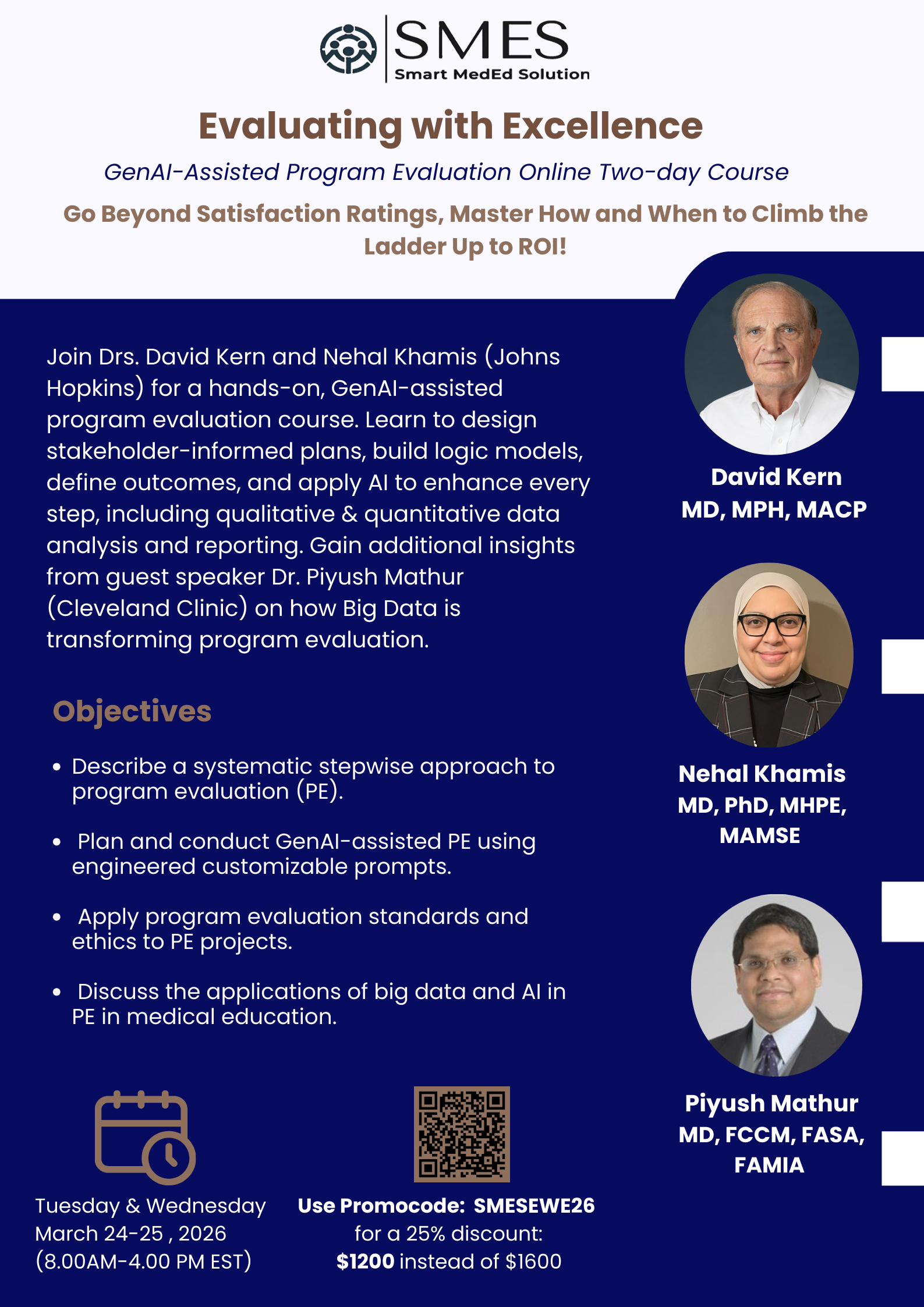
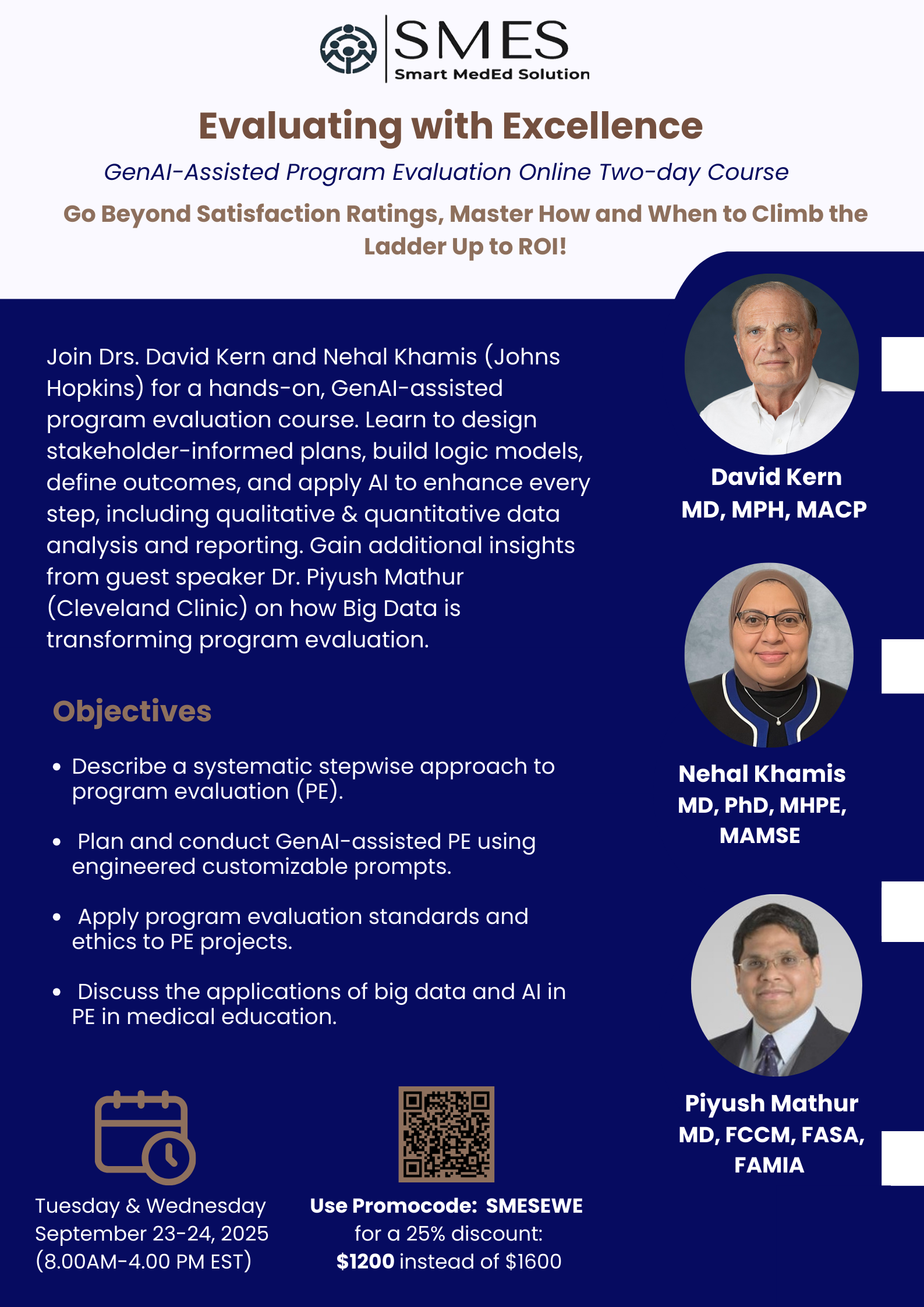
Evaluating With Excellence
AI Assisted Program Evaluation Online Course- October 19, 20 & 21, 2026
(9 AM- 2 PM ET)
Use Promocode SMESPE26 for 25% Discountat Checkout ($1200 Instead of $1600)
Overview
Program evaluation is essential for demonstrating educational effectiveness and guiding continuous improvement, yet many health professions educators find it complex, technically demanding, or difficult to translate into a practical and defensible evaluation plan.
This immersive three-day online course provides a structured, stepwise, and GenAI-assisted approach to program evaluation. Participants will work through the major steps of evaluation, including stakeholder engagement, logic model development, evaluation questions, study design, measurement, evidence gathering, interpretation, and reporting.
Participants will apply the approach to an educational program or evaluation challenge from their own context using structured templates, guided brainstorming questions, and customizable engineered GenAI prompts to progressively build a meaningful, credible, and stakeholder-centered evaluation plan.
The course emphasizes responsible GenAI use that improves efficiency and supports exploration and refinement while preserving critical thinking, methodological judgment, interpretation, and accountability, and reducing risks of cognitive offloading, de-skilling, and never-skilling.
Led by Drs. Patricia Thomas and Nehal Khamis from Johns Hopkins University, with a guest session by Dr. Piyush Mathur from Cleveland Clinic, the course combines program evaluation expertise, practical application, and real-time faculty guidance to help participants move beyond satisfaction surveys toward stronger evidence of educational outcomes and impact.
What You Will Learn
By the end of this course, participants will be able to:
Apply a structured, stepwise approach to design meaningful and credible program evaluations.
Develop a stakeholder engagement plan and construct a logic model to clearly describe a program and its intended outcomes.
Formulate focused evaluation questions and select appropriate designs, methods, measures, and sources of evidence.
Determine the validity evidence needed to support evaluation measures and conclusions.
Analyze and interpret quantitative and qualitative data, including structured approaches to stakeholder consensus and attribution.
Determine how far to move up the evaluation ladder, including when to assess higher-level outcomes and return on investment (ROI).
Use customizable engineered GenAI prompts ethically and transparently while preserving critical appraisal, methodological judgment, and evaluator accountability.
How You Will Learn
This course features a highly interactive blend of:
Short expert-led presentations
Step-by-step application of a structured program evaluation framework
Hands-on small-group work using templates, guided brainstorming questions, and customizable GenAI prompts
Structured breakout discussions and application to real-world evaluation challenges
Presentation of group work with real-time faculty feedback and coaching
Guided use of GenAI that supports efficiency while preserving participants’ own evaluation skills and judgment
A live guest session exploring AI and Big Data in program evaluation
Who Should Attend
This course is ideal for:
Health professions educators and program directors
Directors, assistant/associate deans, and vice deans responsible for assessment, program evaluation, or CQI
Faculty development and curriculum leaders
Simulation educators and leaders
Educational researchers and scholars
Professionals involved in evaluating educational, training, or workforce development programs
Whether you are new to program evaluation or looking to strengthen your current approach, this course provides a structured process, practical tools, customizable GenAI prompts, and expert guidance that you can apply directly to your own evaluation work.
Course Faculty
Patricia Thomas, MD, FACP
Emeritus Professor of Medicine, School of Medicine, Johns Hopkins University, and first editor of the famous “Curriculum Development in Medical Education: A Six-Step Approach” Book.
Nehal Khamis, MD, PhD, MHPE, MAMSE (affil.)
Adj. Prof of Health Professions Education and AI Applications in HPE, Masters of Education in Health Professions Program, Johns Hopkins University, FAIMER Program Evaluation Consultant, Member of ROI of Simulation National Taskforce, & ACS Accreditation Surveyor
Guest Speaker
Piyush Mathur, MD, FCCM, FASA, FAMIA
Associate Professor and Innovation Lead, Department of Anesthesiology, Cleveland Clinic Learner College of Medicine, Case Western Reserve University and Co-founder, BrainX AI, Cleveland, Ohio.
Related Publication
The course design is informed by our published work on responsible GenAI integration in health professions education, drawing on experience from multiple Johns Hopkins and Smart MedEd Solutions courses, including Evaluating with Excellence.
Khamis N, Ungaretti T, Kern DE. Eleven Tips for Designing and Implementing Responsible AI Use in Health Professions Education Courses. Medical Science Educator. 2026. doi:10.1007/s40670-026-02697-5
Course Dates
Monday, Tuesday & Wednesday, October 19, 20 & 21, 2026
(9.00 AM-2.00 PM EST)
Course Fees
Please fill the registration form and proceed to checkout to reach the payment page. You will receive a payment confirmation email. This is important to confirm your registration.
Use Promocode SMESPE26 for a 25% discount:$1200 instead $1600.
A payment processing fees of 2.9%+ 0.30 USD is added by the payment processing provider so your total at checkout will be S1236. These processing charges go to the payment provider and not to SMES.
Past Courses